Dr. Allison Siebecker (0:00 – 0:11)
SIBO has been proven to be the main underlying cause of IBS. It’s very common for tests to come back saying a test is negative when it’s really not.
Shivan Sarna (0:11 – 0:15)
Someone was told they had SIBO and then it turned out it was ovarian cancer.
Dr. Allison Siebecker (0:15 – 0:20)
All we could do before, just give some things for symptoms. Now we can target the bacteria.
Shivan Sarna (0:20 – 1:04)
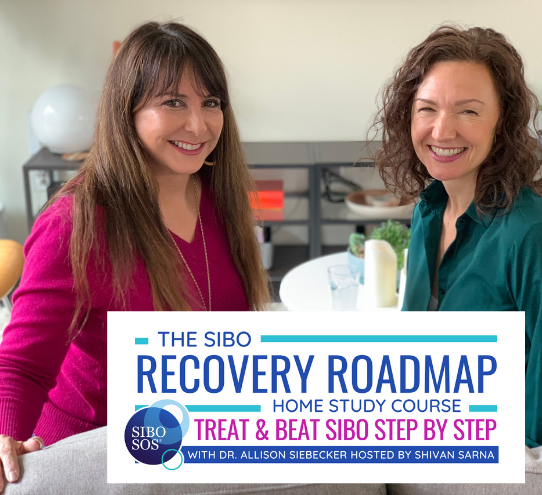
Hi, I’m Shivan Sarna and this is The Shivan Show. I have a very special guest today. My dear, dear friend, truly a soulmate, Dr. Allison Siebecker. Hi, Dr. Siebecker. Hi.
Hello. Let’s get everybody set with this SIBO situation. It’s small intestinal bacterial overgrowth.
We’re going to talk about what it is, what it isn’t, symptoms, as well as what you can do about it. And because there’s so much misinformation or partial information about this condition out on the internet and in the world, we take this very, like I said before, seriously, but also in a relaxed fashion. So, Dr. Siebecker, what is SIBO?
Dr. Allison Siebecker (1:05 – 3:23)
It is an overgrowth, like its name sounds, an overgrowth of actually particular bacteria or similar organisms to bacteria called archaea in the small intestine. And now the definition has expanded or the large intestine that basically interfere with digestion and absorption and cause a whole bunch of symptoms. These are the symptoms of IBS.
And really just right up front, any discussion of SIBO, we probably should mention IBS, Irritable Bowel Syndrome, because many people know about IBS or they’ve heard of it, but they may not have heard about SIBO. SIBO has been identified and proven to be the main underlying cause of IBS. So IBS is really just a group of symptoms, really.
And of course, IBS and SIBO have the same symptoms. And the symptoms are abdominal bloating, which could also be called distension, but it’s when the abdomen swells out or feels like it’s swelling out. But for many people, it really swells out like a balloon.
It could be abdominal pain or just discomfort, and then constipation or diarrhea or a mixture of constipation and diarrhea. That’s called IBS mixed or SIBO mixed. And then there can be other symptoms.
Those are the main symptoms, but other symptoms would be like flatulence or belching, nausea or feeling like food sits in the stomach and won’t go down. There can be anxiety, sometimes depression. Fatigue is really common.
There could be brain fog. There’s a lot that can go on. Acid reflux is actually common for a lot of people.
Now we know that IBS is predominantly caused by SIBO. There could still be IBS. It’s about 60% to 70% of IBS is caused by SIBO.
So, you know, 30% to 40% is something else. But it’s very important to know now that SIBO is a main underlying cause of IBS because we can treat it. All we could do before for it is just give some things for symptoms.
But now that we know that there’s a bacterial overgrowth, we can target the bacteria. And if we get rid of those or decrease them, we can affect all the symptoms. And we don’t have to just give something for each symptom.
So, of course, whenever you know what’s underlying something and you can target that, you have much greater success.
Shivan Sarna (3:23 – 3:47)
This is like a wedding cake because there are underlying causes and then there are the underlying bacteria and they’re caused by other things. And then these overgrowths cause other things. In the middle, let’s call it the frosting or the filling of the cake, is the beloved migrating motor complex.
Would you explain what that is, please? It’s so not discussed.
Dr. Allison Siebecker (3:47 – 5:45)
This is a form of movement or peristalsis in the intestines. Most people know what peristalsis is. It’s like that slow churning mixing movement that occurs after we eat to just move the food down and present it to the walls of the intestine so it can be absorbed.
Well, this is a form of movement that is not when we’re eating or after we’ve eaten. It’s when we’re fasting. So like in between meals or overnight.
And its purpose is to really clean up after we’ve eaten. And so it has the nickname as the housekeeper wave. And so we can just imagine it coming in and kind of like washing the dishes after eating and because there’s actual bile and enzymes and they kind of act like soap and water and then sweeping up, like sweeping the floor where all the crumbs fell.
And the migrating motor complex is this movement comes along with bile and enzymes. But then it’s this movement that sweeps everything down and out. So the reason that we’re talking about it at all is because it’s the body’s number one and main protection against getting overgrowth in the small intestine because it happens throughout the day in between meals and overnight.
So it happens a lot, sweeps the bacteria, any bacteria that might be there in the small intestine that might be wanting to overgrow, sweeps it down and out of the small intestine. Now, just like how many people know that the large intestine has like a bacterial population called the microbiome that’s there and that’s positive and should be there, the small intestine has that too. So the migrating motor complex doesn’t sweep that away like they live in harmony together.
It sweeps away like something that shouldn’t be there, like an overgrowth. So if that becomes deficient or fails, which is common, actually, we get overgrowth. It’s just like imagine a stream or a river that isn’t flowing well now and stops flowing.
It’s going to turn into a swamp with bacteria overgrowing.
Shivan Sarna (5:46 – 6:04)
So when the migrating motor complex is impaired, it leads to the possibility, probability of SIBO, small intestinal bacterial overgrowth. When we’re talking about those underlying causes, what’s the number one underlying cause of impairment for the migrating motor complex?
Dr. Allison Siebecker (6:05 – 9:03)
It’s actually food poisoning, which is a surprise when you first hear about it. That’s a disease, but it’s an acute disease, meaning it’s short-lived, as opposed to a chronic long-term disease. Other names for it would be like medically acute gastroenteritis, and in this case, acute bacterial gastroenteritis.
And then common other terms we could use would be traveler’s diarrhea or stomach flu. So there are different causes of these. There can be viral, bacterial, parasitic.
And the main one we’ve identified with SIBO is bacterial. So not everybody who gets food poisoning will go on to develop SIBO. Maybe they had a viral organism instead of a bacterial.
And even everybody who gets bacterial food poisoning may not go on. You know, it’s not like it’s 100% right. But food poisoning is so common, so common.
I mean, if you just think of stomach flu and food poisoning, pretty much everybody’s had it. And many people have had it really more times than they can count. So statistics show about maybe 10% or 11% on average of cases of food poisoning will go on to develop SIBO.
But you can still understand how many people that might be. I mean, we know how many people have IBS. It’s up to 20%, 25% of the world’s population.
And, you know, up to 70% of those have SIBO. So we can then understand this. But the way that food poisoning is related to the migrating motor complex and SIBO, causing SIBO, is that it actually instigates an autoimmune process where the bacteria that cause food poisoning secretes a toxin.
And it looks really similar to one of our nerve cells, to a protein on one of our nerve cells that exists in the small intestine. And so through a process of autoimmunity, other terms are cross-reactivity or molecular mimicry, or you could think friendly fire, the immune system starts attacking its own nerve cell in the small intestine while it’s trying to attack the toxin. Then by attacking this nerve cell and this protein on this nerve cell, this nerve cell is very, it’s called the interstitial cells of Cajal.
They’re vitally important to perform the migrating motor complex. If the cell goes down, studies have shown the migrating motor complex becomes deficient. After a certain threshold, and then slowly, then maybe a little bit over time, and once that becomes deficient, someone will develop SIBO.
So after food poisoning, sometimes the symptoms change a little bit from the really acute presentation, and then they’ll sort of move into the IBS symptoms, and they just sort of move right into SIBO. But for many people, there’s a delay, and it could be anywhere from one to six months from having food poisoning to when they develop the SIBO. And that really is confusing.
It throws everybody for a loop because you’re not thinking back. You may not even, if it wasn’t a really severe or bad case of food poisoning, you may not even remember it.
Shivan Sarna (9:03 – 10:59)
Okay, we’re going to continue to get personal. Have you ever been bloated, like really bloated? Have you ever had diarrhea or constipation or maybe have a combination of all of it?
Maybe you have SIBO, small intestinal bacterial overgrowth. I have answers for you, the ones that I couldn’t find for so many years. The website, my website, sibosos.com, has a ton of free information, some premium courses you can take, small group coaching, and discounts on supplements and other health products. What changed everything for me was working with Dr. Allison Siebecker, and she is involved in so many of these projects. She is a true and legitimate SIBO expert. So if you’d like to work with us, you’d like to find out more, even just want to just take a little look and see if maybe that might be you, then check it out.
You’ll see the links in the description. And I hope you don’t have SIBO, but if you do, I’m glad we found each other. How many times in SIBO small group coaching have we talked to people and we’re like, so it could be food poisoning.
And they say, oh, I’ve never had food poisoning. And then we’re like, you know what? At some point, go get the IBS Smart test through Gemelli Labs.
Let us know what the antibody test shows, which is referring to what you were just talking about. And lo and behold, they have the antibodies being positive, which means that they have post-infectious IBS, which is what we’re talking about here. But there are a lot of other ways you can get SIBO too.
But this is the most overlooked, the most sort of people get incredulous about like, oh, how could that be? That was when I was five. This is one of the things that Dr. Mark Pimentel and Dr. Ali Rezaie, who are at the MAST Program at Cedars-Sinai, who are doing just this amazing research and work to really cure SIBO. And their work has been so instrumental in helping the whole world understand this condition.
Dr. Allison Siebecker (10:59 – 11:43)
Dr. Pimentel spent years working on this and finally proved it all. So we just have such a huge gratitude to Dr. Pimentel and his teammates for figuring this out. And currently, and for many years, he’s been, as you said, working on a cure.
And basically, he’s developing a drug that can decrease the antibodies. You know, if the antibodies keep going, we keep damaging the nerve cells. And he’s made great progress.
It’s still going to be, at this time we’re recording, you know, some years out because drugs take time to be tested and come to the market. But there will be basically a cure for SIBO caused from food poisoning.
Shivan Sarna (11:43 – 12:48)
Very, very exciting, since that’s how my food poisoning started and then led to SIBO. From milking a cow, we’ve like, on a field trip, you know, when you’re little, whoever was watching over us as kids on this like farm in upstate New York looked away. And then we were like, oh, you know what?
Let’s taste the milk. Like, what was I thinking? Very sick, very sick.
And then a trip to India that didn’t go well for me food-wise. And that’s a really good point to make for those of you who are like, huh, food poisoning. Once you have it and you have this sort of context set up or this perfect storm set up, you are more likely to get the next bout of food poisoning.
And so that explains why everyone can have lunch at the same picnic and eat the warm potato salad. You get sick and no one else does. And they’re like, oh, it must not be food poisoning because Mary ate the same thing you did.
Well, Mary hasn’t had three other bouts of food poisoning. All those buffets and the Thanksgivings and the Christmases, just make sure the cold food is really cold the way it’s supposed to be. And the hot food is really hot the way it’s supposed to be.
Dr. Allison Siebecker (12:48 – 13:30)
Yeah. And actually, you mentioned the IBS Smart Test. So just to put an exclamation point on that or whatever, that is the test that we use to find out if somebody has had food poisoning caused their SIBO.
We can actually figure that out. That’s what that test lets you know. It’s a blood test.
So it’s very simple. I think it’s like a finger prick or something like that. So it’s a very simple, easy test.
And honestly, it’s the most common test that I order when we really don’t know why somebody has SIBO. And we’ve really talked a lot about their history and looked at many things. It’s the first thing I order because so many people don’t remember the incident.
And then it comes positive. And then we know.
Shivan Sarna (13:31 – 14:27)
Knowing what your underlying causes are, one of them, really changes your, obviously for myself, my compliance with taking a prokinetic, which is something that helps to harmonize the migrating motor complex, which helps to prevent relapse. And it’s not a laxative. I just want to put that out there because I know a lot of people, that’s another distinction.
I ask people in small group coaching and in our courses and Q&As so frequently, are you on a prokinetic? That Dr. Siebecker, for my birthday, had a t-shirt made for me. I should be wearing that now.
The t-shirt says, are you on a prokinetic? Because I ask it so many times and so many times the answer is no. And it is such a critical and overlooked part of the protocol.
There’s a lot of questions about how do I find out, Dr. Siebecker, if I have SIBO? I’m bloated. I have weird bowel patterns.
I sometimes have pain in my belly. I feel like I can’t eat Italian food anymore. How could I tell?
What’s the testing like?
Dr. Allison Siebecker (14:28 – 16:33)
Yeah, it’s pretty simple. It’s a breath test. And these tests can actually be ordered yourself on my website and probably on yours too.
We’ll put the links here too. Or you can have a doctor order it for you. But the breath test, there’s basically what you do is you do a one-day prep diet where you reduce carbohydrates, which includes plant foods, so vegetables and fruits and grains and things like that.
And then you fast overnight. And then the next morning, you drink a sugar solution. And that’s called a substrate.
And there are different ones. But the one that I like the best is lactulose for this test. And that is now well-supported by studies.
There used to be controversy on that. And so the lactulose, here’s where we have a slight problem, is that as a holdover from an older time, it’s prescription in the US. It shouldn’t be.
It’s safe. There’s nothing dangerous about it. But it would cost a lot of money to get it off the formulary.
So that’s where sometimes people can have a hard time obtaining these tests. But there are labs that will directly deal with patients and get them lactulose breath tests. You sample your breath.
And you drink the sugar solution. And then you sample your breath every 15 or 20 minutes for three hours. And then you mail it off.
And a lab will analyze it. And what we’re measuring are the gases that the overgrown bacteria or archaea produce. And that’s hydrogen, methane and hydrogen sulfide.
And this gives us our different types of SIBO, basically. And the interpretation guidelines, it’s very important to, I would say, just look at my website for the interpretation guidelines. It’s really important that you not just look at the lab report’s analysis.
Because there are different ways to interpret. As a whole, we’ve tried. The industry has tried to standardize.
But not everybody has the same opinions. So you can look at the interpretation criteria on my website, SIBOinfo under testing. Because it’s very common for tests to come back saying a test is negative when it’s really not.
Shivan Sarna (16:34 – 16:34)
Right.
Dr. Allison Siebecker (16:34 – 16:36)
So this happened to Shivan Sarna. You want to tell your story?
Shivan Sarna (16:36 – 17:46)
It’s a long story about how I went and got the breath tests. It’s in my book, Healing SIBO. When we finally did look at the paper versus just them reporting to another doctor, negative or positive, it had positive written down, crossed out, and then the letters N-E-G for negative.
So they didn’t know how to interpret the test, is the bottom line. And I lost 18 months of additional confusion, stress, money, rabbit hole after rabbit hole. I was so frustrated.
And the only thing we came up with is you have a motility disorder. OK. Which causes SIBO.
Which causes SIBO. Getting the interpretation right is so important. And we do have a masterclass, the SIBO testing masterclass, that if you want to really know how to do it right, get the most out of the test, increase your chances of having an accurate test, find out what you can do at home, find out what you can do as an alternative to the typical lab test and what the labs are all about, check out our SIBO testing masterclass.
Dr. Siebecker created this beautiful, beautiful masterclass that you will know more than most practitioners out there in the world about SIBO testing. Yeah, and it’s only an hour long, too.
Dr. Allison Siebecker (17:46 – 18:39)
But this brings up a really important point, which is that you actually can’t diagnose SIBO without the test. And it’s actually written into the definition that it’s a clinical syndrome. And as part of the definition, you need to be both exhibiting symptoms and have proof, basically with a test, of the overgrowth of the bacteria.
So you need both, right? If you have a positive test and you have no symptoms, you don’t have SIBO. And if you have symptoms and a negative test, you don’t have SIBO, right?
So long as the interpretation is correct on that negative. But the issue here is that the symptoms I described of IBS and SIBO are very common symptoms that many other diseases can cause. Probably about 40-ish other diseases can cause the same symptoms.
So we can’t tell by the symptoms. You have to have a test. So it’s very important.
Shivan Sarna (18:39 – 19:05)
Like candida, parasites, even ovarian cancer. They’re like, it’s a full spectrum of things that cause the same symptoms. And so it’s really important to get tested.
So nobody’s guessing. I’ve heard about that very sad case where someone was told they had SIBO, and then it turned out it was ovarian cancer. This is not common, but it happened.
And so it’s something that’s a cautionary tale.
Dr. Allison Siebecker (19:06 – 19:29)
Yeah. And also, our treatments, which we’re going to get into, I’m sure, soon, are antibacterial in nature, antimicrobial in nature. I think we all know we don’t want to be using antibacterials if they’re not needed and called for and appropriate for the circumstance.
We all, I think, have now heard of the importance of the microbiome, things like that. And we don’t want to do these things unless it’s the correct thing to do.
Shivan Sarna (19:29 – 19:44)
It’s a microbiome condition. It’s a motility condition. It’s a malnutrition condition.
In some cases, a biomechanical underlying cause. You could have adhesions. You could have endometriosis, strictures.
Dr. Allison Siebecker (19:44 – 19:50)
It can be just anatomical. And with adhesions being a very common cause of SIBO also.
Shivan Sarna (19:50 – 20:30)
And what an adhesion is is an internal scar. So if you’ve ever had a cesarean, if you’ve ever had any abdominal surgery, then you may have adhesions. But it could also be from the softball that hit you in the belly when you were a kid.
It could be from a fall. Internal scars that are holding you together. And thank goodness they are, right, in many cases.
But it can lead to a pulling of the tissue that then impacts the migrating motor complex, basically. You may have a strong migrating motor complex, but some of that tissue may be like an endometriosis, right? It could be pulling your intestines in a way.
It’s a plumbing issue, right? It doesn’t flow the way it does.
Dr. Allison Siebecker (20:30 – 20:46)
Yeah, it’s actually more like a log jam. Like it’s a, we call it an obstruction. Really, it’s a partial obstruction.
It’s like a physical obstruction to allowing the bacteria move through the intestine and get out. So even if the migrating motor complex is doing its job, there’s a block.
Shivan Sarna (20:46 – 20:51)
Let’s talk about treatments. So there are three main ones. Which one do you want to start with?
Dr. Allison Siebecker (20:51 – 21:12)
I’ll say what they are. So the antimicrobial treatments that we have are pharmaceutical antibiotics, or prescription antibiotics, herbal or natural antibiotics, and elemental diet, which maybe we should call elemental formula just because so many people get it confused with diet of what you’re eating. This is an antimicrobial treatment, elemental diet.
Shivan Sarna (21:13 – 21:40)
AKA liquid diet for a certain period of time. Well, why don’t we start with that one? Let’s do that.
Hi, I’m Shivan Sarna, and this is The Shivan Show, health, wealth, and wisdom. Be sure to hit subscribe as well as ding that bell so you get notifications every time a new show drops. Let’s train the algorithm together to make sure you get this incredible transformation information that’s not just more data dubbing, but can actually change your life for the better.
Thanks for being here.
Dr. Allison Siebecker (21:40 – 24:30)
Okay. So it’s a medical food beverage, as you were just sort of describing, where basically it’s like powdered nutrients, or sometimes they come already as a liquid, and it’s going to be a drink. And then the nutrients are just all of our nutrients in most broken down form.
The idea with it is that it absorbs quickly into our body before it gets a chance for the bacteria to eat it or ferment it. I mean, their kind of eating is fermentations. And so it starves them.
Now there are some thoughts about new ways elemental diet is working. The established way we have always thought is that it’s basically starving the overgrown bacteria, and it takes some time. Dr. Pimentel has always said it takes at least 10 days, and we typically do this for 14 days. He’s the one who came up with the protocol for this, for SIBO, and studied it and published and proved. And then they have continued work on this, and they now have studies showing 100% eradication rate. It’s the highest eradication rate of any of our treatments to date.
So just incredible. It’s always been a very successful treatment, although I will just say that out of these three treatments, it certainly happens that sometimes one or more may not work for a person where another one will. That just is part of the individuality of people.
So that happens. So don’t get discouraged if you try a treatment and it doesn’t seem to work. I want to talk about how we know whether a treatment works or not.
But let me just first finish elemental diet. You can also do it for three weeks. The way Dr. Pimentel did this is you test after two weeks to see if it’s gone. And if it’s not gone, you could continue for a third week if you feel you can do that. And then you would stop after three weeks. So elemental diet, you’re not eating solid food at the same time in the way this protocol was originally developed.
You can have water. Maybe you could have some herbal tea or black coffee. But for the most part, you’re not supposed to, you know, so it still can be hard because you’re just drinking this, you know, basically the shake for two weeks.
That can be a little challenging. What its advantage is, is that compared to our other two treatments, pharmaceutical or herbal antibiotics, it can lower more gas in that same time period. In that way, it’s a little bit more effective.
It can lower 100 or even 150 parts per million of gas. What’s positive is 20 for hydrogen, 10 for methane, although there’s some differences there. And now, one and a half for hydrogen sulfide.
That’s brand new information from Dr. Pimentel. So, you know, we can have people go into the hundreds for their positivity. And that’s where elemental diet is amazing because in two weeks, you could potentially, if it worked on you, get rid of all of it, you know, in just two weeks.
Shivan Sarna (24:30 – 25:35)
It’s a heavier lift. Some people are like, oh my gosh, I never want to come off this liquid shake as my nutrition because, but you must, because I feel so good. Other people are like, oh, I couldn’t wait to get over it.
What I found really interesting is talking to Debbie Steinbach, who is a specialist in the elemental diet, a nutritionist. And she said that the taste changes over the time of the course of your treatment. Your relationship to it kind of changes.
You got like you go through this like transformation with this beverage over the time that you’re doing it, which I found to be interesting because sometimes those first couple of days are really tough, but then like people can sometimes crave it while they’re doing the treatment. So if it sounds intimidating or even you’ve done it for like a day or two and thought not for me, if you can hang in there, the results that we’ve seen, I know you’ve seen so many patients get resolved. And then just recently in our small group coaching, we’ve had a lot of people be like, I didn’t believe it was going to work.
And it did.
Dr. Allison Siebecker (25:36 – 25:39)
We have some discount codes we can include for people.
Shivan Sarna (25:39 – 25:39)
A hundred percent.
Dr. Allison Siebecker (25:39 – 26:33)
And also there’s all different brands of these with different flavors, but you wouldn’t even have to just do one. You could, you know, buy some of each different kinds of different flavors. One of the biggest things people get concerned about with elemental diet would be the concern of potential weight loss.
And what we have found is, especially if somebody is coming into it already underweight, what we have found is that so long as you consume the recommended amount of calories, which is 1800, or you could even increase it to 2000, there isn’t real weight loss. What most people will experience is a little bit of water weight loss, usually in the first two or three days of, you know, usually no more than four-ish pounds. And of course, water weight will just return when you begin eating.
That is acceptable for most people, and it’s not substantial weight loss. So that’s just something I wanted to mention because people get really concerned about it.
Shivan Sarna (26:33 – 27:23)
It’s not your average protein powder. So this is not the shake that you’re used to. It’s not your fitness shake.
It’s not what you probably have in your cabinet right now that you picked up at the health food store or on Amazon or something. This is a very specific medical food. And on your Fullscript dispensary, there is a variety of the elemental formulations, and you can find that under the protocols in your Fullscript dispensary, and there’ll be a link below for you all to be able to have access to that with her exclusive pricing.
I have no problem about interspersing these types of money-saving ideas throughout the presentation because, you know, I like to pinch a nickel so hard I make it cry. So I like to help you save time, energy, and money. Okay, so let’s move on to another one of the treatments.
Dr. Allison Siebecker (27:23 – 27:27)
Let’s talk about pharmaceutical antibiotics. Most people are familiar with those.
Shivan Sarna (27:27 – 28:08)
Well, in this first part, we covered so many important things with Dr. Allison Siebecker, SIBO specialist, like the migrating motor complex, like bloating, distension, diarrhea, constipation, alternating diarrhea and constipation. And the MMC cannot be overstated. And it’s one of the things that is missed most when people talk to us about SIBO.
It’s like there’s a blind spot about the migrating motor complex. Not everybody, but so many people. So I’m so glad we covered it.
That concludes the first half of our session with Dr. Siebecker. Be sure to come back and watch the second half where we cover those treatments, including the antibiotics and so much more. So we’ll see you then.
Why Does SIBO Keep Coming Back After Treatment? | Dr. Allison Siebecker, Part 1
Why does SIBO keep coming back after treatment, when you did everything you were told to do?
Usually because the thing that let it happen is still there. IBS is a group of symptoms rather than a cause, and small intestinal bacterial overgrowth is one of the things that can sit underneath them. Somewhere around 60 to 70 percent of IBS cases may come back to SIBO, which leaves a sizable share that is something else.
Key Insights
Dr. Allison Siebecker is a SIBO specialist and the practitioner whose work changed everything for me. She has spent years treating this condition and teaching people how to test for it.
What SIBO Actually Is
Dr. Siebecker describes SIBO as an overgrowth of particular bacteria, or similar organisms called archaea, in the small intestine. They interfere with digestion and absorption.
Those symptoms are the symptoms of IBS. Bloating or distension, abdominal pain, and constipation, diarrhea or a mixture. Then flatulence, belching, nausea, anxiety, fatigue, brain fog and acid reflux.
The distinction matters because it changes what can be done. The options used to be aimed at each symptom. Once bacteria are known to be involved, the bacteria can be targeted.
The Housekeeper Wave in Your Gut
Peristalsis is the churning movement that happens after you eat. The migrating motor complex is different. It runs when you are fasting, between meals and overnight.
Dr. Siebecker calls it the housekeeper wave. It arrives with bile and enzymes that act like soap and water, then sweeps what is left down and out. It is the body’s main protection against overgrowth in the small intestine.
When it becomes deficient, and that is common, overgrowth can follow. She uses the picture of a river that stops flowing and becomes a swamp.
How Food Poisoning May Set It Off
The most common thing that impairs it is food poisoning. Acute bacterial gastroenteritis, traveler’s diarrhea, or what most of us call a stomach bug.
Dr. Siebecker explains the mechanism as an autoimmune one. The toxin from those bacteria closely resembles a protein on a nerve cell in the small intestine, so the immune system attacks its own cell while going after the toxin. Those cells run the migrating motor complex.
Not everyone who gets food poisoning develops SIBO. She puts it at roughly 10 to 11 percent of cases. The delay is what makes it hard to spot. It can be one to six months, and a mild episode may not be remembered at all.
There is a blood test, IBS Smart, that looks for the antibodies. In coaching we hear people say they have had no food poisoning, and then the test comes back positive.
Why Symptoms Alone Cannot Tell You
You cannot diagnose SIBO from symptoms. The definition asks for both symptoms and a test showing the overgrowth. A positive test with no symptoms is not SIBO, and neither are symptoms with a correct negative test.
Around forty other conditions can produce the same picture. Candida, parasites, adhesions, endometriosis, and in one case I heard about, ovarian cancer. That is not common, and it is a cautionary tale. Dr. Siebecker also points out that these treatments are antibacterial, and none of us want to use those when they are not called for.
What a Breath Test Involves, and Why Interpretation Matters
It is a breath test. One day of a prep diet that reduces carbohydrates, an overnight fast, then a sugar solution the next morning. Dr. Siebecker prefers lactulose. You sample your breath every 15 or 20 minutes for three hours and send it to a lab, which measures the gases the overgrowth produces. Hydrogen, methane and hydrogen sulfide give the different types of SIBO.
Interpretation is where this falls down. She is clear that you should not rely on the lab’s own analysis alone, because the industry has not fully standardized and it is common for a test to be reported negative when it is not.
That happened to me. When we finally looked at the paper rather than the report, it had positive written down, crossed out, with NEG next to it. I lost 18 months to that.
Where the Elemental Diet Fits
There are three antimicrobial treatments. Prescription antibiotics, herbal antimicrobials, and the elemental diet, which Dr. Siebecker suggests might be better called an elemental formula, because people confuse it with what they eat.
It is a medical food. Nutrients in their most broken down form, taken as a drink, absorbed quickly enough that the overgrown bacteria do not get to ferment them. The protocol typically runs fourteen days, with a test after two weeks.
It is a heavier lift, because you are not eating solid food for that stretch. The concern people raise most is weight loss, and Dr. Siebecker’s answer is that when the recommended intake is met, most people see a little water weight early on that returns once they eat again. Any of this belongs in a conversation with your own practitioner.
Why Prokinetics Come Up So Often
A prokinetic helps harmonize the migrating motor complex, and it may help prevent relapse. It is not a laxative, and that gets missed a lot. I ask people in coaching so often that Dr. Siebecker had a t-shirt made for my birthday with the question on it.
If you have spent years being told it is just IBS, the useful next step is not another supplement. It is finding out whether there is an overgrowth at all, and making sure whoever reads that result knows how to read it. Be your own detective. There is hope, and there are answers. I’m glad we found each other.
Part two covers the treatments in more depth, including prescription antibiotics and herbal antimicrobials, in Episode 03.
Show Notes & Resources
https://sibosos.com/healing-sibo-book/
https://www.youtube.com/@allisonsiebecker4595
https://sibosos.com/podcast-sibonavigator
Use code Gut25 to save $25.
https://www.gemellibiotech.com/products
Shop over 15,000 practitioner-grade supplements, explore Dr. Siebecker’s curated wellness plans, and enjoy exclusive pricing.
https://sibosos.com/podcast-fullscript
Use code NOBLOAT15 to save.
https://sibosos.com/podcast-microbiomelabs
Use code 10SS to save.
https://sibosos.com/podcast-promolife
https://sibosos.com/podcast-whrs
https://sibosos.com/podcast-lymphsummit
https://www.instagram.com/shivansarnaofficial/
Subscribe to The Shivan Show
Listen, watch, or subscribe to The Shivan Show:



This episode is for general information only and is not medical advice. Nothing here is intended to diagnose, treat, cure or prevent any condition. Talk to your doctor before making changes to your care.